

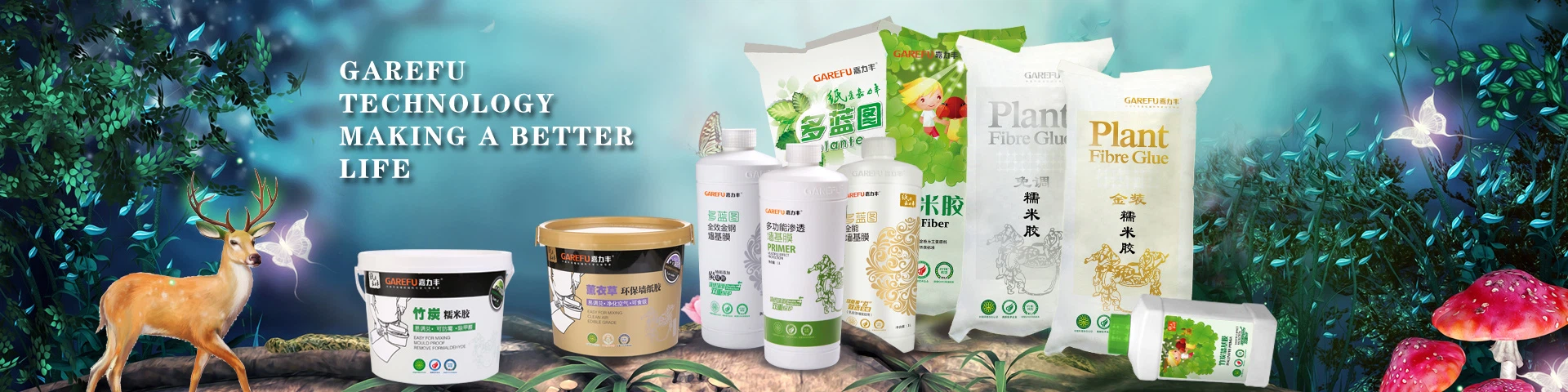
Wall Interface Agent is multiple functional interface agent which uses Acrylic polymer as main ingredient and been added several functional materials. It has the characteristics of strong permeability, good sealing and high pulling strength. Garefu interface agent has the ability to open pores, water resistance, and make the base layer wet, so as to achieve effective results, improve the penetration of the base layer interface, and effectively prevent hollowing, cracking, and mildew. Suitable for interior decoration ground base surface protection.
Product Advantages
Durable and low maintenance
low maintenance system. The use of lime in mortars contributes to the durability of this system.
Elasticity
Research has shown that high lime content mortars were slow hardening and remained elastic or flexible. Lime, therefore, enhanced the ability of the assemblage to accommodate stresses caused by building movement and cyclical changes without excessive cracking.
Autogenous healing
When hairline cracks develop in the mortar, hydrated lime reacts with carbon dioxide in the atmosphere. This reaction produces limestone which helps to seal the crack.
Proven performance
Prior to the early 1930's, all masonry buildings were constructed with lime or a mixture of cement and lime. Portland cement was not manufactured in the United States until 1871. Prior to this, lime was used as the primary ingredient of all mortars. The durability of these structures serves as testimony to the lasting durability of lime mortars.
-

Wall And Ground Consolidation Interface Agent
Garefu interface agent is multiple functional interface agent which uses Acrylic polymer as main
Add to Inquiry -
Garefu ground solidification agent is made of high-quality polymer and base material, looking for
Add to Inquiry -
Garefu wall interface agent is multiple functional interface agent which uses Acrylic polymer as
Add to Inquiry


Our Of Products
We offer professional interior painting services, we will select the best colors for the walls of your room and ensure a flawless application of paint for a beautiful and updated design of your home or office.
One-stop Solution
When you work with us, you can count on personalized, one-on-one service every step of the way. We earn your trust by being responsive, intuitive and honest. We earn your respect by delivering on time and on budget. We built our reputation on exceptional customer service. Discover the difference it makes.
Professional Team
We are a team ideas and creators。We're constantly evolving our products to reach even higher standards for design, quality, manufacturing, and environmental sustainability.
Custom Service
With state-of-the-art technology and high-end skills, we will customize the products in the ways you have thought of and even beyond that. The designs are tailor-made and can be altered as per your needs.
Applications
Treatment agent for treating the surface of the object
It can achieve the adsorption and coating of the surface of the object through physical methods. This is the most common kind of physical and chemical effects. The function of the interface agent improves the original characteristics of the surface of the object. For example, interface agents can be used to improve or change the physical properties of the wall surface, as well as some chemical characteristics of the surface.
The role of interface agent
The purpose is to change the physical and chemical properties of the wall surface. In addition, the surface can also be treated. At this time, it is called an interface modifier, and the other is called a surface treatment agent. In fact, they are all interface agents, but the functions realized by the processing function are different.
The action type of the interface agent
Generally can be divided into four common types. Like now, interface agents are used in many fields. However, it is divided into four categories according to the surface treatment methods of the interface agent and the required requirements. It is the common wetting and dipping, coating treatment, coupling agent treatment and surface modification. We can choose the interface agent corresponding to the processing function according to our requirements.
Other types
Interface agents that are often used in our home improvement include concrete surfaces, aerated concrete surfaces, small blocks, lightweight partition walls, and brick-concrete walls. Its function is to satisfy the scraping of our putty, the bonding of ceramic tiles and the construction of insulation board materials and so on.

How to construct the interface agent during home decoration?
The use of interface agents is very simple. Generally, it is to use roller brushing or spraying method to spray the interface agent on our base layer or the surface of the wall. Like the common cement, sand, and interface agent we use, the ratio is 1:2:0.5. Mix it evenly and apply it directly. The common operation steps are as follows.
Grassroots cleanup. If we want to apply the interface agent, we must clean up the base layer. The focus here is to clean up the dust, garbage, oil and so on on the surface of the grassroots. Make sure that the base layer is clean, tidy and dry before applying the interface agent.
Mixing and construction of materials. The interface agent needs to be mixed evenly. Before construction, we can use a special electric mixing machine or other mixing tools to mix the materials evenly and then set aside. When painting, use a roller brush or a fur brush to paint on the wall. In the end, the interface agent is evenly brushed on the base layer, where it cannot be missed, so that the application of the interface agent is completed.
For our home decoration, it is not necessary to use interface agents. Because the interface agent is the base layer treatment to meet our surface decoration needs. Therefore, when decorating our home, we must divide it into different situations to choose the interface agent correspondingly.
Interface agent can be used when plastering the surface of smooth wall. What I'm talking about here is actually the plastering of concrete walls in our home. This situation is generally common in self-built houses or newly built buildings. On the smooth concrete surface, because it is not easy to bond, it is usually treated with an interface agent to avoid the hollowing of the plaster layer and peeling off.
Replaster the original old walls during the renovation of the old house. It is also recommended that you use interface agents. In other words, if we renovate the original old house during the renovation of our home, many friends at this time will remove the putty layer on the original wall surface. After removing it, it is found that the original plaster layer is not strong enough, and then the layer may be brushed. Interfacial agent, or in some cases, shovel off the plaster layer directly, and then apply the interfacial agent. Finally, plastering is done, which does have a good effect.
The plastering layer on the surface of the indoor wall, we feel that it has a certain strength, that is, it is very strong, but when it feels sandy after scratching with a hard object, you can also brush the interface agent. In fact, this is a slight sand on the wall, but the situation is not particularly serious. In this case, you can also use the interface agent to brush 1-2 times. In this way, the loose surface and sanding of the surface can be treated to a certain extent, which provides a good foundation for our later batching of putty.


Currently, the total number of our distributors is more than 50,000, which remains at more than 50% annual growth of the turnover and top rank of both the annual output value and sales quantity among Chinese wallpaper industry.
FAQ
Q: What is difference between cement and mortar?
The basic difference is that concrete is a mixture of cement, water and aggregates, cement is a fine binding powder used as an ingredient in concrete (and never used alone) and mortar is composed of cement, water and sand.
Q: What is a mortar used for?
Q: Why use mortar instead of concrete?
Q: Is mortar stronger than brick?
Q: How do you make mortar stronger?
Q: Does mortar need a bonding agent?
Q: What are the 3 main types of mortar?
Q: What are the 4 most common types of mortar called?
Q: Can you patch cracks with mortar?
Q: Can i use mortar as grout for flagstone?
Q: Will mortar stick to old cement?
Q: How long does mortar last once mixed?
Q: Should you spray mortar?
Q: Does mortar act like glue?
Q: Which type of mortar has highest strength?
Q: Will mortar stop a leak?
Q: Can water get through mortar?
Q: Can mortar be made waterproof?
Q: Why does mortar bubble?
Q: What does lime do in mortar?
We are professional interface agent manufacturers and suppliers in China, specialized in the business of wallpaper adhesive. Please feel free to wholesale bulk interface agent at competitive price from our factory.
